Our member organizations span much of Northern California- see where they’re located and learn more about them below. Please reference the website for each site to verify its operating hours.
Chinese Historical Society of America, San Francisco
CHSA serves as a center for research, scholarship, and learning, inspiring greater appreciation for the Chinese American experience and promoting its rich legacy.
Angel Island Immigration Station Foundation, Tiburon
For all immigrants, descendants, and families, Angel Island is a living landmark that symbolizes diverse experiences of detention, racism, exclusion, hope, and determination. The Angel Island Immigration Station Foundation protects the historic site, elevates its stories, promotes learning, and celebrates the new beginnings and immigrant contributions that define the strength of the US. We inspire a more equitable and inclusive future; one that embodies how immigrants make nations better.
Physical Location: Angel Island in San Francisco Bay
Mailing address: 870 Market St., Suite 901, San Francisco, CA 94102
Chinese Historical and Cultural Project San Jose, San Jose
We promote, educate, and preserve Chinese and Chinese American history and culture through community outreach activities. We share our stories, our history, and our culture with the people of Silicon Valley and beyond.
Operated by the Isleton Museum. The Isleton Bing Kong Tong (BKT) was established in 1903 as an affiliate of the San Francisco Bing Kong Tong Benevolent Society by Toy Tue, a local merchant and mayor of Chinatown. Its purpose was to provide a place for meeting, worship and resolution of problems in the Chinese community. The Bing Kong Tong Association built the current structure at 29 Main Street in 1926 following a fire which leveled all the structures on Main Street. From 1933-1942 the 2nd floor served as a meeting place for the BKT and the 1st floor was a Chinese Language School for the children. In the 1940s the BKT quit its operations in Isleton. In 1994 the San Francisco BKT deeded over the building (including its contents) to the Isleton Brannan-Andrus Historical Society. Since then, there have been an attempts to renovate the structure. Now these efforts have culminated in stabilization of its structure and exterior (completed in 2014) and its utilities interior (2020).
Physical Address: 29 Main Street, Isleton, CA 95641
The Auburn Joss House is a historic monument to preserve the past for the future, protect the legacy of the ancestors, and inform and educate visitors about the many contributions the Chinese made, and how their customs and cultures helped shape this country.
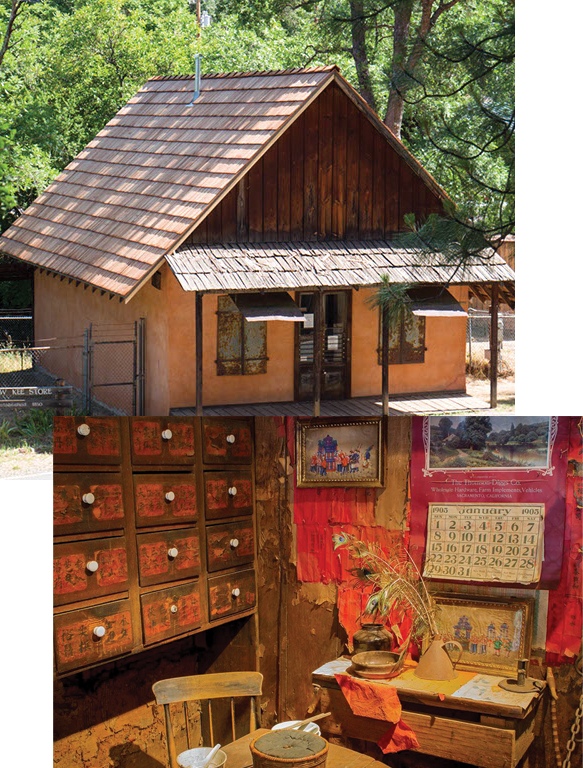
Operated by Fiddletown Preservation Society. Originating as a Chinese medicinal herb pharmacy, the Chew Kee Store served as a store, community center and home for Chinese immigrants from 1855 to 1965. Everything inside the store is authentic, reflecting the daily life and work of its various residents: herb doctor Yee Fung Cheung, who founded the store in the mid-1850s; followed in the 1880s by merchant-gambling house operator Chew Kee and wife Sigh Choy; and their adopted son “Jimmie” Chow (Fong Chow Yow) who was born in 1885 and died in Fiddletown in 1965– much loved by the community and the only Chinese person buried in its public cemetery. Each resident left behind objects that tell the story of Chinese culture transplanted to Gold Rush California.
Chinese American Museum of Northern California, Marysville
The focus of the Chinese American Museum of Northern California is the forgotten history of the Chinese in America. The Chinese built over thirty Chinatowns in California during the gold rush. Almost all have been destroyed or abandoned, so little exists to remind us of their importance in the early settlement of this state. The Marysville Chinatown is the last Chinatown of the gold rush era. It still has an active temple, the old Chinese school building, three Chinese associations and a traditional Chinese festival.
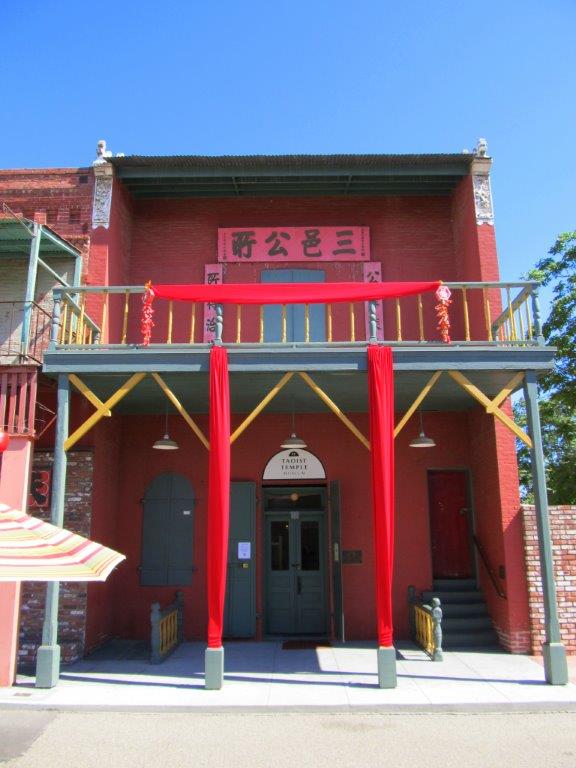
Operated by the City of Oroville. Built in 1873 to serve the largest Chinese community north of Sacramento, this vibrant temple is both a living place of worship and a fascinating museum. Listed on the National Register of Historic Places and a California Landmark, it first opened to the public during the 1949 Centennial and continues to celebrate Chinese heritage today.
Related organizations: The Stockton Chinese Cemetery, The Museum of Chinese in Stockton
China Alley Preservation Society, Hanford
The China Alley Preservation Society is dedicated to preserving, protecting, and revitalizing the historic heart of Hanford’s Chinese community. We honor the stories, architecture, and cultural legacy of those who built and sustained China Alley, ensuring its spirit endures for future generations.
Our mission is to protect, preserve, and promote the Temple of Kwan Tai, its artifacts and traditions and to enhance public understanding of Chinese immigrant history as seen through the eyes of Mendocino County Chinese.
Physical address: 45160 Albion Street, Mendocino, Ca 95460
Mailing Address: Post Office Box 633, Mendocino, CA 95460
The Helen and Joe Chew Foundation’s (HJC) is a humanities based non-profit using Chinese American history as a form of education and cultural enrichment to inspire the general public and the next generation to pursue higher education in a rural community.
The Eureka Chinatown Project is an initiative by community members and Humboldt Asians & Pacific Islanders in Solidarity (HAPI) to honor the history and culture of the first Chinese people in Humboldt County, California.

 Chinese American Heritage Network